
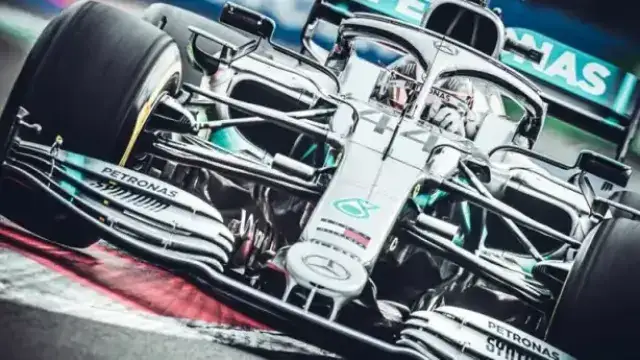
Ride height. That was the confession, in the end. After the ground-effect era had closed, the FIA's single-seater director Nikolas Tombazis said it out loud: the optimum ride height of the cars had moved much lower than anyone behind the 2022 regulations had expected, and nobody — not the governing body, not the teams — had raised it in time. "It was something that became obvious very, very close to the start of the championship, when it was too late to change the regulations."
A few millimetres. That is what four seasons of Formula 1 turned on: how close a floor could run to the road before the air underneath it gave up. Ground effect had been banned in 1983 for making cars too fast to race safely. Its 2022 return produced cars bouncing violently down straights — porpoising, caused by tunnels of moving air, a wooden plank, and a suspension suddenly asked to do an aerodynamicist's job.
Lotus built wings under the car
The idea is nearly fifty years old. Lotus pioneered modern ground effect with the 78 in 1977 and the championship-winning 79 in 1978, sculpting sidepods into inverted wings and sealing the low-pressure zone beneath the car with sliding skirts. Air squeezed under the car speeds up and drops in pressure. Low pressure sucks the chassis toward the road. The car corners as if the road itself were pulling it down.
It worked too well. Cornering speeds and the g-loads on drivers climbed until the FIA judged them unsafe, and from 1983 flat bottoms were mandated and skirts banned outright. When ground effect returned, it did not return as an experiment nobody understood. It returned as a known force, deliberately reshaped by people who thought the reshaping had tamed it.
The 2022 return reshaped the concept: mandatory Venturi tunnel geometry, no skirts, and a stated goal of cutting dirty-air losses so cars could follow more closely. The seal was now made with bodywork edges and controlled vortices rather than physical skirts — a skirt is a wall, a vortex is a suggestion that holds only while the flow behaves. The underfloor became a full-length device, from the front of the sidepods to the rear of the floor, with leading edge, throat and diffuser forming one continuous Venturi system. No part of it could misbehave without the rest noticing.
Put a figure on it and the shift stops being abstract. Around 60 percent of a modern car's downforce comes from the floor and diffuser, with the wings and upper bodywork — once dominant — now in support. The surface nobody sees, facing the road, did most of the work — and it is the most sensitive to ride height, the most powerful lever in the aerodynamicist's toolkit, and the most dangerous.
The bounce had a cycle to it
If the floor gets too close to the ground, the airflow beneath it can stall. Vortices formed by the floor's front strakes burst. Underbody flow collapses, and downforce falls off sharply. The suspension, no longer held down by aerodynamic load, rebounds. As the car rises, the aerodynamics stabilise, downforce returns, and the airflow sucks the car back down — where it stalls again. Down, stall, up. Down, stall, up. A cycle, repeating at speed, with a driver sitting in the middle of it.
That oscillation is porpoising: a high-speed vertical bounce that, in its worst 2022 form, was severe enough to cause floor damage and discontinuous tyre contact-patch loading. Then there were the drivers. Complaints about back pain, and potential spinal consequences, turned an engineering curiosity into a welfare argument — the sort of territory where modern biomechanics and load tracking have changed how sport treats the bodies inside the machines. A car can be repaired between sessions. A spine keeps its own records.
The mechanism was not guesswork. A peer-reviewed analysis in the journal Energies traced it to marked nonlinearities in downforce along ride-height variation: downforce increases at an accelerating rate as the car gets lower, until a critical speed where the aerodynamics can no longer "hang on." Tiny ride-height changes produce huge load changes. In this world, the response grew faster than the change — so the limit didn't approach politely. It arrived.
Teams responded the only way available to them. They raised ride heights and stiffened floors and suspension to stay out of the unstable zone, at the cost of downforce. The teams that could run low without bouncing dominated the early seasons. That sentence carries the whole competitive story of the era: the championship was, in large part, a contest over who could live closest to a stall without falling into it. Telemetry is how they knew: underfloor pressure taps, laser ride-height sensors, accelerometers capturing the vertical oscillation signature. Engineers compared wind-tunnel and CFD predictions against those track readings, and the gap between the two — the correlation error — is where development programmes live or die. Reading it correctly determined whether a team chased an aerodynamic fix or a mechanical one.
A wooden plank, policed like a wing
The wooden plank — the skid block beneath the car — became the era's key regulatory instrument. Originally it limited how low teams could run by wearing away on track contact, with strict wear limits at scrutineering. With the 2022 cars, though, running the whole floor as close to the ground as possible became advantageous, making the entire plank a performance limitation rather than just a rake limiter, as Formula 1's own technical coverage explained. Inevitably, the plank got clever. Teams explored ways to give it a more cushioned, flexible effect near the Venturi tunnel's stall point — delaying porpoising so the car could run lower and generate more downforce. A wear strip, fitted to stop cars running too low, was being engineered to help cars run lower for longer.
The FIA's response was a technical directive on floors, first applied at the 2022 Belgian Grand Prix. It standardised the skid-block mounting method and tightened floor-stiffness policing, judging it unfair to apply the same vertical-acceleration limits to different interpretations of the flexibility rules. The regulator was no longer just measuring wings. It was policing how a floor bent and how a block was bolted on, because that was where performance now lived.
Testing, meanwhile, was rationed. The FIA's Aerodynamic Testing Regulations limit wind-tunnel time and CFD simulation runs, with allocations pegged to championship position — better-placed teams get less — and the cost cap constrains spending on top. Wind-tunnel scale models must predict what happens on bumpy real-world asphalt, and the teams with the least testing time cannot afford to waste it.
Suspension geometry became the hidden battlefield. With the floor's performance tied to ride height, the suspension turned into an aerodynamic control device, and the trade-off is brutal. Run low and stiff and you maximise the Venturi effect but invite porpoising and plank wear. Run higher and softer and you buy stability over kerbs but surrender downforce. There is no setting that wins both sides of that trade. So teams chased kinematics that keep the floor's attitude stable as the car pitches under braking and rolls through corners, avoiding the load spikes that trigger the stall cycle. The porpoising era rewarded the teams whose aero and chassis departments operated as one unit rather than in sequence. A floor designed without the suspension in the room would arrive at a ride height the suspension couldn't hold.
Which brings the story back to Tombazis, standing at the end of the era. "The fact that the optimum [ride height] of the cars moved so much lower was a miss in the 2022 regulations. It's something that we missed — and not only us but also the teams. In all discussions, nobody raised that issue." The initial porpoising, massively improved since, had also not been anticipated. "I wish we had done better there." Admissions like that are rare in any sport's governing body. This one lands because the evidence had been bouncing down straights, in front of cameras, since the era began.
For 2026, the wings move
The ground-effect era ended after 2025, and the 2026 regulations rewrite the rulebook around active aerodynamics. For the first time, F1 has full-time active aero: both wings adjust their angle depending on where the car is. In Straight Mode the flaps open to a low-drag position on designated straights. In Corner Mode they snap back to high downforce. Formula 1's official beginner's guide describes the system as available to all drivers on designated straights — a successor to DRS, retired after its run since 2011. The downforce problem hasn't been solved so much as redistributed: less of it asked from the floor, more of it managed, moment by moment, by wings that change their minds corner by corner.
The cars shrink, and the numbers describe a deliberate slimming. Wheelbase drops 200 mm to 3.4 m. Width falls 100 mm to 1.9 m. The front wing becomes 100 mm narrower with a two-element active flap, the rear wing becomes a three-element active design, and the beam wing is removed. Tyres narrow by 25 mm at the front and 30 mm at the rear. Minimum weight falls to 768 kg. The "nimble car" concept targets up to 30 percent less downforce but roughly 55 percent less drag, with active aero compensating on straights. Whether the racing rewards that argument is a question the new era will have to answer on track.
With the big Venturi tunnels gone and ride-height sensitivity reduced, porpoising should disappear from the F1 lexicon. The phenomenon that defined an era — argued over the way cricket argues over a perfect chase or a captain's tactical legacy — becomes a historical curiosity. That may be the era's real legacy. Ground effect came back with nearly fifty years of history behind it, a ban on its record, and a redesign meant to civilise it — and it still found the one variable nobody had priced in, a few millimetres of ride height. The lesson they carried isn't: in a sport measured in millimetres, the smallest number in the rulebook can turn out to be the one that runs the whole era.
Football arrived at the same data-first mindset from tactics: Champions League quarter-finals are now dominated by high pressing and inverted wingers.
Sources
- Formula1.com — "TECH TUESDAY: Understanding the Technical Directive on floors" (2022 Belgian GP; plank wear, skid-block standardization): formula1.com
- Autosport — "Porpoising explained by the architect of F1 2022's technical rules" (ride-height mechanism, Venturi stall, vortex burst): autosport.com
- MDPI (Energies) — "Analyzing Porpoising on High Downforce Race Cars" (nonlinear downforce vs. ride height): mdpi.com
- F1i.com — "FIA admits to key oversight during F1 ground-effect era" (Nikolas Tombazis quotes via Motorsport.com): f1i.com
- F1-Fansite glossary — "Ground effect in F1: Lotus origins, 1983 ban and 2022 return" (Lotus 78/79, flat-bottom mandate, ~60 percent of downforce from floor/diffuser): f1-fansite.com
- F1-Fansite glossary — "F1 aerodynamics explained" (dirty air, porpoising, ATR sliding-scale testing limits): f1-fansite.com
- Formula1.com — "The beginner's guide to the 2026 Formula 1 regulations" (Straight/Corner Mode active aero, 3.4 m wheelbase, 1.9 m width, 768 kg): formula1.com
- ESPN — "2026 F1 rules: What's new on the cars" (driver-activated active aero in designated zones, wet-weather limits): espn.ph
- Autocar — "F1 2026 for beginners" (50/50 power split, end of porpoising): autocar.co.uk
- ScuderiaFans — "F1 2026 explained" (two-element active front flap, three-element active rear wing, beam wing removal): scuderiafans.com