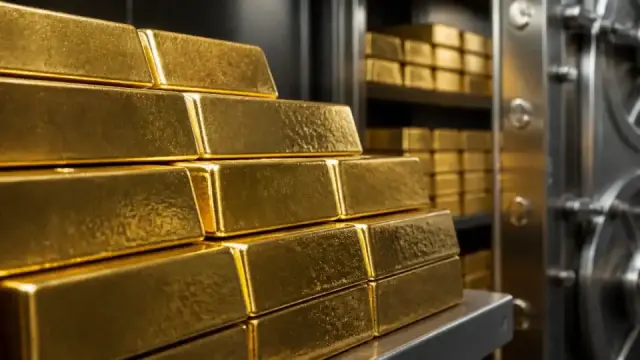
Textbook economics says record prices cool demand. Central banks read a different textbook. In the second quarter of 2026, official institutions bought 288.9 tonnes of gold — up 62% from a year earlier, the strongest second quarter in the World Gold Council's records — and they bought it while the price was sliding, months after the metal's January peak. That peak: the LBMA afternoon benchmark fix printed $5,405.00 per ounce on January 29, and intraday trading pushed as high as $5,595.47, according to World Gold Council data. The buyers who set records in January and the buyers who kept purchasing all year were not the same people.
Why the second group behaves that way tells you more about the global financial order than any price chart does.
A record, then a 26 percent slide
The run into January had been building for a year. Through 2025, global gold demand exceeded 5,000 tonnes worth a record $555 billion, and prices recorded 53 new all-time highs, according to the World Gold Council. January added the accelerant — geopolitical tension, dollar-weaponization fears and relentless official-sector buying — and the metal blew through to its historic peak. Then came the long slide down. By late September gold traded around $4,157, roughly 26% below the January intraday peak and about 20% below the $5,405 record fix. The driver was not mysterious. The US 10-year inflation-protected real yield climbed to 2.85% on September 24, its highest since November 2008. Gold pays no coupon, and when inflation-adjusted bond yields sit that high, the opportunity cost of holding the metal turns punishing. The Federal Reserve's September rate hike to 3.75%–4.00% reinforced the pressure.
And yet the aggregate numbers refused to collapse. First-half 2026 demand still reached 2,522 tonnes valued at $380 billion, per the World Gold Council, and the second-quarter average price remained 37% higher year on year. The speculative top blew off, and the structural floor underneath it kept being reinforced. The real-yield mechanism governed everything after January. Gold yields nothing. A Treasury, adjusted for inflation, currently yields 2.85% — the most since November 2008. Every ounce of gold an investor holds is therefore a decision to forgo that guaranteed real return. In January, at peak fear, investors judged the insurance worth any price. By September, with real yields at a seventeen-year high, the same investors demanded a discount — and the price obliged, sliding about 20% from the record fix even as the fundamental bid underneath never wavered. The metal did not fall out of favour. It fell out of urgency.
The buyers who don't watch the price
The conventional model says volume shrinks as prices rise. Central banks have spent 2026 invalidating it. The World Gold Council's Gold Demand Trends report, published April 29, 2026, showed net official purchases of 244 metric tonnes in Q1 alone — up 3% year over year and 17% above Q4 2025's 208 tonnes. Q2 then set the second-quarter record at 288.9 tonnes. The motivation is structural, not tactical. As analysts at Discovery Alert have documented, the five-year quarterly average for central bank purchases runs at roughly double the average of the preceding five years. Sovereign buyers are not trading the price. They are executing a slow, deliberate decision to hold less of their national savings in another country's currency and legal system — the same impulse reshaping how emerging markets settle trade beyond the dollar. Every episode in which dollar assets are frozen, sanctioned or threatened converts more reserve managers to the same conclusion. This is not a view on next quarter. It is a view on the next decade.
That is what makes the official bid price-insensitive in a way no private buyer can replicate. Official gold is not leveraged, carries no stop-losses, does not watch the FOMC calendar, and does not sell into a 5% rally. Poland has been among the most consistent accumulators. In July the World Gold Council recorded 23 tonnes of net buying, with China and Poland logging the largest purchases. In August, China's central bank expanded holdings by 20.2 tonnes, its biggest monthly increase in nearly three years. Market watchers expect official-sector buying to average around 50 tonnes a month over the full year. Honesty demands the nuance, though. First-half demand of 345 tonnes was the lowest for any first half since 2022, and reported year-to-date buying of roughly 130 tonnes trails the ~160 tonnes over the same period in 2025. The record Q2 masks a slower start to the year. The bid is powerful, but it is concentrated among a subset of committed accumulators rather than broad-based. Concentration cuts both ways: a floor built by a handful of determined sovereign buyers is sturdier than one built by leveraged speculators, because it does not vanish on a bad week — but its thickness depends on the continued resolve of a relatively small group of reserve managers. If that group ever paused in unison, the market would learn very quickly how much of the bid beneath the price was structural, and how much was sentiment wearing a structural costume. For now, the accumulators show no sign of pausing.
The second bid runs through ETFs
If central banks supply the floor, a second institutional buyer supplies the swings: gold ETFs. The World Gold Council reported record August inflows of $18 billion into physically backed gold ETFs, lifting total holdings by 121 tonnes to a record 4,189 tonnes. Physically backed ETFs have now logged ten consecutive weeks of net inflows; the most recent week showed $1.72 billion of subscriptions against $1.59 billion of redemptions. August marked the third-largest monthly ETF inflow on record (Société Générale analysis). The motive rhymes with the central banks': a persistent institutional desire to hedge portfolios against monetary and geopolitical risk, expressed through a liquid wrapper. Goldman Sachs Research, which forecasts gold at $4,900 per ounce by end-2026, estimated July central bank purchases at 44 metric tonnes on its own model, with the three-month trend at 91 tonnes per month on a seasonally adjusted basis.
Put the two bids together and the year's price behaviour stops looking strange. When real yields spike, ETF holders feel the pain and some sell; central banks don't. When geopolitical risk flares, both buy. A market whose marginal buyer is a leveraged trader gaps down when yields jump and gaps up when fear spikes. A market whose floor buyer is a reserve manager with a multi-year mandate slides, orderly, and then stops, because beneath the slide sits a bid that is not calculating returns at all. The 26% drawdown looked dramatic on a chart. Measured against the buying underneath it, the surprise is not that gold fell. It is that it fell so politely.
What gold actually insures against
Gold's reputation as an inflation hedge deserves more precision. The metal does not track the consumer price index month to month. It often struggles most when inflation is high but real yields are rising faster — precisely the 2026 configuration, and precisely the tension tracked in OmniWire's coverage of Federal Reserve policy and real yields. What gold actually hedges is not inflation as such. It is the policy and currency regime that inflation can produce: negative real rates, currency debasement, financial repression, geopolitical fracture. Seen through that lens, 2026 makes sense. The January record was peak fear about all four at once. The subsequent 26% decline was the market's judgment that the disorder would arrive more slowly, and that 2.85% real yields were adequate compensation for waiting. Central banks, whose horizons are measured in decades, never shared the urgency of either move. They just kept buying through both.
For individual investors, the lesson is unfashionable: gold works best as a small, permanent allocation — portfolio insurance held through cycles — rather than a tactical trade on the next CPI print. The metal's journey from $5,595 to $4,157 illustrates both roles from opposite ends. Traders got burned chasing the top. Patient accumulators kept building, much as dividend growth investors building passive cash flow get paid for endurance rather than timing. What could reignite the rally? Analysts point to two plausible catalysts: a fall in the 10-year real yield below roughly 2.40%, most plausibly triggered by a credit or equity event that forces the Fed off its projected hiking path, and a genuine re-acceleration in reported central bank buying above 30 tonnes a month. Absent one of those, the nearer obstacle is technical: the September lower high around $4,467. Until gold clears that level, the downtrend from January remains intact. A planned summit between Donald Trump and Xi Jinping is also drawing institutional attention to the metal as a hedging tool.
The dashboard, from here, is unusually clear. The real yield is the throttle: below roughly 2.40%, the rally case reopens. Reported central-bank buying is the breadth gauge: above 30 tonnes a month, the bid is widening beyond its committed core. And $4,467, September's lower high, is the line that separates a correction from a resumed uptrend. Three numbers, each measuring a different buyer. Gold's 2026 has been the story of those three buyers disagreeing. The next chapter is the story of which one blinks first.
Disclaimer: This article is general information for educational purposes only and is not investment advice, financial advice, or a recommendation to buy or sell any asset. Markets are volatile and past patterns do not guarantee future results. Consult a licensed financial professional before making investment decisions.
Central-bank buying explains the floor under gold; it does not explain the timing of each spike. That still comes from US rates, and the Fed's outlook for real yields and credit spreads remains the chart gold traders watch. A younger competitor for the same defensive money is emerging in parallel — Bitcoin's institutional liquidity wave of ETF inflows and treasury allocations — though it behaves like a risk asset on gold's haven days. For the rate itself, see today's gold price in Pakistan, .
Sources
- World Gold Council via Khan Capitals — "The Gold Price Rally: From $4,000 to $4,700 on Record Central Bank Buying" (Q2 288.9t, record; Aug 26 close $4,677) — khancapitals.com
- Respect Investment — "Gold Price Prediction: $4,286 Spot, $4,750 Bull, $3,850 Bear" (record $5,405 fix Jan 29; real yield 2.85%; July 23t buying) — respectinvestment.com
- Discovery Alert — "Central Bank Gold Buying at Record Prices in 2026" (Q1 244t, +3% YoY; 5-year average double prior period) — discoveryalert.com
- SRC Swiss Resource Capital via pr-web — "Gold symbolizes reliability" (Goldman $4,900 forecast; Aug $18B ETF inflows; 4,189t record holdings) — pr-web.com
- Global Investments — "Gold Is Down 26%. Central Banks Bought Anyway" (Sept 28 price $4,156.76; Q2 289t) — globalinvestments.net
- ad-hoc-news.de — "Gold ETFs Log Tenth Straight Week of Inflows as Record Yields Cap the Upside" (10th week; China +20.2t August; Q2 289t) — ad-hoc-news.de
- World Gold Council via NordFX/FinanceWire — record 2025 demand >5,000t ($555B, 53 all-time highs); H1 2026 2,522t ($380B) — webdisclosure.com
Explore live market benchmarks, 360° hardware specifications, and regulatory customs duty breakdowns updated daily: