
The demo videos are a liar's format. Bipedal machines stride, grasp, climb stairs, and the clip ends before the shift does. So set the videos aside and open the deployment ledger instead, because as of mid-2026 it tells a narrower and far more interesting story. A small number of humanoid robots are doing real, documented, repetitive work at a small number of named sites. One company has logged tens of thousands of operating hours. Another is selling machines by the thousand at a price no Western competitor will touch. And the most discussed program on the planet has not sold a single unit.
That is the honest scorecard for humanoid robots in industrial logistics: who has actually deployed, what the machines are doing all day, and what the numbers look like when somebody counts them.
Digit did the shifts
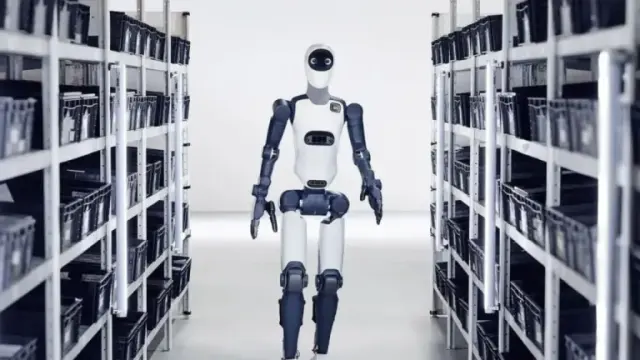
If any company has earned the right to talk about deployment, it is Agility Robotics of Salem, Oregon. Its robot, Digit, is a bipedal machine with distinctive bird-like legs and gripper-style hands, built for logistics rather than for looking human. By the company's account, backed by independent verification, Digit is the first humanoid robot commercially operational in warehouse and industrial facilities. First matters less than this, though: it is still working.
The hours are the strongest evidence in the industry. More than 65,000 operating hours across nine customer facilities. Named customers, not anonymous pilots: GXO Logistics, Schaeffler, Toyota Motor Manufacturing Canada, Mercado Libre and Amazon. At GXO's logistics center alone, Digit robots have reportedly moved over 100,000 totes.
Read that figure again. A hundred thousand totes, at one customer's site.
That is not a pilot programme. That is warehouse work, the kind measured in throughput and uptime rather than applause. Behind it sits RoboFab, Agility's Oregon plant and one of the world's first purpose-built humanoid factories, with annual capacity of 10,000 units. The company reports $300 million in Digit contract orders. In June 2026 it announced a planned SPAC merger with Churchill Capital that would value it at $2.5 billion and make it the first publicly traded company devoted entirely to humanoids, with backing from Amazon, Nvidia, SoftBank and Foxconn.
The design explains the lead. Cofounder and chief robot officer Jonathan Hurst has said the team "never set out to build a machine that looks like a person" — the legs are shaped for the work, and the hands are grippers rather than five-fingered replicas. Specialisation buys reliability: Digit's grippers post very high grasp success rates on warehouse containers, and the Agility Arc software platform plugs into existing warehouse management systems so fleets can be run as fleets. In July 2026 the company opened a 60,000-square-foot training facility in Fremont, California, pointedly near Tesla's Optimus factory. CEO Peggy Johnson welcomed the geography: "For a long time, Agility has operated alone in the humanoid robotics field. Having Tesla in the same area is a good thing."
Then the financials, which are candid about how young this category is. Around $1.8 million in 2025 sales, against a $140 million operating loss. The $300 million order book is multiyear and unprofitable at current margins. Agility sells Robot-as-a-Service arrangements so buyers can avoid upfront capital expenditure, and every deployed robot is, for now, a subsidised proof point. The bet is plain: volume eventually repairs the unit economics. Maybe it does. The hours say the machines work; the accounts say the business doesn't, yet.
One job, done repeatedly, parts counted
Figure AI holds the second-strongest deployment evidence, and it looks different. Its Figure 02 and 03 humanoids are full-size bipeds with five-degree-of-freedom hands, developed with AI partnership support from OpenAI, and aimed at the general-purpose end of the market. At BMW's Spartanburg plant they have logged more than 1,250 hours and loaded over 90,000 parts.
Smaller numbers than Digit's. Still a landmark, because of their shape: a named customer, a named site, a counted output. That is evidence a procurement team can evaluate, and in humanoid robotics it remains rare enough to be notable.
The approach differs from Agility's specialisation. Figure wants a machine that can be told what to do — natural-language tasking, vision-language-action models, a robot that interprets spoken commands instead of running one fixed routine. In September 2025 the company announced a strategic partnership with OpenAI and Microsoft to integrate advanced multimodal reasoning, enabling natural-language task execution and self-improving learning loops. It is the same bet the wider software industry is making on reasoning models that plan and use tools: put a stronger brain in the loop and the body becomes more general. The BMW deployment proves the generalist approach can do at least one industrial job repeatedly and measurably. One job, done repeatedly, parts counted. The open question is whether one job becomes five.
The loudest robot hasn't shipped
Tesla's Optimus is the most discussed humanoid robot on earth. It is also, on the only metrics that matter commercially, the least deployed. The honest summary: internal factory presence, no published industrial KPIs, no external commercial sales, with external shipments targeted for late 2026 at the earliest. In January 2026, Elon Musk himself said the robots were not in material factory use at Tesla's own facilities. Units have been shown doing battery sorting and parts transfer, in controlled settings.
None of that makes Optimus a failing programme. A humanoid robot has roughly 10,000 components, and serial production of anything like it has no precedent in manufacturing history. Tesla's Model 3 ramp in 2017–2018 took more than eighteen months to reach stable volume with a far simpler product. Missing an aggressive target is normal for hardware this hard. But arithmetic is arithmetic: Optimus needs 12 to 24 months of external deployments before it can compete with Digit on audited, third-party-verified operating history. For a humanoid you can deploy in the next two to three years, Optimus is a contender for the future, not the present. Until external units are working customer shifts, Optimus competes on footage. Digit competes on hours.
The rest of the field refuses to sit still while the Western three argue. Unitree of China has become the volume leader by units shipped: approximately 5,500 humanoids in 2025, with 10,000 to 20,000 targeted for 2026, and its G1 sells for around $16,000 — a price no Western competitor matches, with Western industrial machines priced significantly higher and exact figures generally undisclosed. Unitree's deployment case data is thinner than Agility's. Commercial availability at that price is itself a market event; a machine a mid-size warehouse can actually buy changes who gets to experiment. Boston Dynamics' Atlas, now fully electric with the hydraulic version retired, remains the most athletically capable humanoid ever built, with pilots at Hyundai and Google DeepMind and shipments scheduled for 2026. 1X Technologies' NEO aims at a safety-first design for eventual home and commercial use. Sanctuary AI and Fourier Labs keep working on general manipulation. Honda's fifth-generation ASIMO platform, upgraded in October 2025, is in long-term trials in healthcare facilities.
The work robots still can't do
Beneath the deployment numbers sits a harder truth. Humanoid robots still cannot work safely alongside people without strict safeguards. Current deployments lean on proximity-triggered shutdowns and structured, separated workspaces. The robot freezes, or the humans are kept out of its lane. Agility's own engineers describe proximity-triggered shutdowns as solving "major, absolute blockers" — blockers discovered only through customer deployments, never in the lab.
The demos show fluid manipulation. The facilities show fences, lanes and freeze triggers. Unstructured environments, varied objects and human coworkers remain at or beyond the frontier, and anyone buying in 2026 should price that in. It is also why the governance question follows these machines through the factory door: when a robot acts in a shared space, somebody's name has to be on the decision, the same accountability problem regulators are now working through for software agents under international AI governance standards.
Three questions decide whether 2026 was the year humanoids crossed from pilots to production. Can Agility convert its $300 million order book into profitable, high-volume shipments from RoboFab, proving the unit economics and not just the technology? Can Figure expand beyond BMW to a second and third anchor customer, proving the generalist actually generalises? And will Tesla's Fremont production start shipping Optimus externally — and what will the first independent operating data show?
The honest summary, then. A handful of robots doing real, documented, repetitive work at a small number of named sites. One Chinese manufacturer shipping in thousands at prices nobody else will quote. The largest programme of all still pre-revenue. Deployment is real. It is also early, concentrated and, at current margins, heavily subsidised. That is not the revolution the demo videos promise. It is something more valuable — the beginning of an actual track record.
There is a useful discipline buried in all of this for anyone watching the sector from outside. Ignore the unit announcements; count the hours. Hours are hard to fake, expensive to accumulate and directly comparable across programmes — they are why Digit's lead is real, why Figure's beachhead matters, and why Optimus, for all its fame, currently has an argument rather than a record. RoboFab's 10,000-unit annual capacity, Unitree's five-figure shipment targets and Tesla's late-2026 shipping aim all describe what these companies intend to produce. The ledger of hours describes what their machines have actually done. In 2026, the second document is the one worth reading — and it is finally long enough to read.
Dexterity at this level is a compute problem wearing a mechanical costume. Keeping inference on the robot instead of in a distant cloud is why neuromorphic microchips promising 10x energy efficiency in edge computing matter to robotics roadmaps. The research frontier reaches further out still: quantum neural networks aimed at enterprise automation are nowhere near a warehouse floor today, but they show where the optimisation layer above these machines is heading.
Sources
- Technology.org — "Humanoid Robots in 2026: What Is Actually Deployed" (deployment scorecard: Digit 65,000+ hours, Figure 1,250+ hours, Optimus status): technology.org
- Singulism — "Agility Robotics Opens Digit Training Facility Near Tesla's Base" (60,000 sq ft Fremont facility, $300M orders, GXO 100,000+ totes, July 2026): singulism.com
- Robozaps — "Tesla Optimus vs Digit: Complete Comparison" (deployment track record, Musk Jan 2026 statement): blog.robozaps.com
- TechXplore/AP — "Agility Robotics heads to Wall Street in a $2.5B bet on staffing warehouses with humanoids" (SPAC merger, $2.5B valuation, June 2026): techxplore.com
- Robotics Business News — "Humanoid & Embodied AI Robotics Market" (Optimus Gigafactory pilot, Figure/OpenAI/Microsoft partnership, Agility Oregon expansion): roboticsbusinessnews.com
- Fourthweb Wire — "Agility's Humanoid Robot Is Programmed to Freeze Around Humans" (financials: $1.8M sales, $140M loss, safety blockers): wire.fourthweb.ai