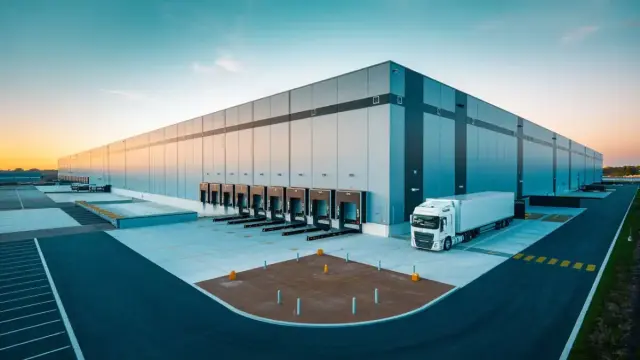
The digital economy has a physical footprint, and in 2026 the rent on it is being collected by real estate investment trusts. Real estate investment trusts spent the early 2020s getting knocked around — rising rates, empty offices, a pandemic that reshuffled where people work and shop. Now the sector is showing real signs of life, and two property types are doing much of the heavy lifting: logistics warehouses and data centers.
Congress set up the REIT structure in 1960 to let ordinary investors hold a share of large-scale commercial real estate, much as a mutual fund lets them hold a share of the stock market. The defining feature is a tax bargain. According to the IRS instructions for Form 1120-REIT, a REIT has to keep at least 75% of its assets in real estate, take at least 75% of its gross income from rents, mortgage interest, or property sales, and pay out at least 90% of its taxable income to shareholders each year. In return, the income it passes through generally escapes tax at the corporate level. That 90% rule is why REITs are income investments: the payout isn't a management preference, it's the price of the structure.
One nuance matters. Taxable income is not cash flow. Buildings are depreciated for tax purposes — a large non-cash expense — so the industry judges REITs on Funds From Operations (FFO), which starts with net income and adds back depreciation and other non-cash items, rather than GAAP earnings. Miss that single distinction and a sound portfolio can look like a money-loser on paper.
The two families behave differently. Equity REITs collect rent from properties they own and run; per an EY/Nareit study, they made up roughly 96% of the nearly $1.42 trillion in listed equity REIT market capitalization at the end of 2024. Mortgage REITs do something else: they finance property by making or purchasing mortgages, leaving them far more exposed to credit spreads and short-term rates. With data as of June 30, 2026, Nareit's fact sheet values the FTSE Nareit All REITs index at $1.627 trillion in market capitalization and puts the commercial real estate owned by REITs at more than $4.5 trillion. Listed U.S. equity REIT portfolios held nearly 570,000 properties at year-end 2024, and publicly listed REITs paid out roughly $66.2 billion in dividends during 2024 — a payout culture that dividend growth investors will recognize, though REIT payouts are legally required rather than voluntarily raised. Per Nareit, the first half of 2026 brought the equity REIT index a return of nearly 15%.
Warehouses won the e-commerce decade
Industrial real estate — warehouses, distribution centers, logistics hubs — is the backbone of online retail, which needs substantially more distribution space per dollar of sales than traditional retail. Online shopping's growth, and then its pandemic surge, handed logistics landlords fuller buildings, leases that ran longer, and real power over pricing.
Prologis, the biggest logistics REIT in the world, illustrates that dynamic in a single set of figures. Its leases signed in 2025 set a record at 228 million square feet, about 20% of the new ones came from e-commerce, and analysts were told that U.S. warehouse vacancy had already topped out, with rents turning positive in some markets, per FreightWaves' coverage.
But the argument reaches beyond the cycle. Supply chains are being rebuilt — more inventory held closer to customers, more manufacturing returning to North America, the same currents driving the trade and settlement shifts pulling production and payments closer to home. Management at Prologis has even made the case that AI is turning into a fresh source of logistics demand, putting the possible gain at 30 to 40 million square feet of extra warehouse space for every $1 trillion of data center capital expenditure. That projection underpinned the company's second upward revision of its 2026 guidance this year, lifting full-year core FFO guidance to $6.22–$6.30 per share. The risks sit elsewhere: too much exposure to tenants sensitive to trade, and development pipelines able to bring on new supply fast once markets overheat.
Server racks joined the portfolio
Data centers barely existed as an investment category a decade ago. The sector entered the FTSE Nareit index family in 2015; by 2026 it had grown to about $127 billion in market capitalization — nearly 9% of the index — per CRE Daily's analysis of Nareit data.
Equinix, the biggest digital infrastructure REIT in the world, is where that demand shows up at full throttle. Per the Commercial Observer, its Q1 2026 annualized gross bookings came to $378 million, the largest quarter in its history, and AI was tied to roughly 60% of its largest deals. Management raised full-year guidance across the board. The economics make the point more sharply: at around 120 kilowatts per rack, NVIDIA's GB200 NVL72 systems sit far past what air cooling can cope with, pushing operators to liquid cooling and redesigned facilities. In 2026, analyst BTIG started coverage of Digital Realty and Equinix with buy ratings, pointing specifically to AI infrastructure investment, while CBRE research pointed to record pre-leasing and tight vacancy heading into 2026. Performance has followed — data center REITs returned 33.2% year-to-date as of June 30, 2026, per Nareit data cited by the Motley Fool. It is the mirror image of the digital asset world's infrastructure growing pains: there, the risk sat in code; here, the infrastructure is the asset, and it can be inspected, leased, and re-let.
Hold the risks alongside the returns. No property type demands more capital than data centers, power is in short supply in key markets, and hyperscale customers carry enormous leverage. These REITs trade more like technology infrastructure than traditional property.
Rates squeeze, growth decides
The mechanism linking REITs to interest rates is twofold. Because REITs borrow to buy and build property, higher rates push their financing costs up and put cash flow under pressure. And REITs compete with bonds for income-seeking capital: when Treasury yields rise, a 4–5% dividend yield looks less compelling next to risk-free alternatives, so investors demand a higher yield — a lower price — to own REIT shares.
The bond-competition half of that mechanism is the one investors feel first, because it requires no change at the property at all. Rents can be rising, occupancy firm, FFO growing — and the share price can still fall, purely because a risk-free Treasury now yields enough that the REIT's dividend must be repriced against it. The income investor is always comparing two cheques: the one the REIT mails and the one the government guarantees.
The post-2022 era demonstrated all of it. Per Hoya Capital, from the Fed's first rate hike in March 2022 through early 2026, equity REITs trailed the S&P 500 by more than 80 percentage points. Yet the same analysis notes the resilience: despite the 10-year Treasury yield climbing to 5.00% early in 2026 and the Fed raising rates for the first time since 2023 — to 3.75%–4.00% in September 2026 — the Vanguard Real Estate ETF was still up roughly 7% in 2026. Research by Nareit itself, summarized by CRE Daily, looked at the period from 1992 through 2026 and found positive total returns from listed REIT indices in more than three-quarters of periods when 10-year yields were rising, and in just as many when they were falling. Economic growth was the distinction that counted: four-quarter returns averaged over 19% at their best, when higher rates came alongside robust GDP growth, and were at their worst when slowdowns accompanied the rate moves. Rates as such are not usually what hurts REITs. The damage comes from the recession those rates are meant to fight, or end up causing. Keep an eye on growth, not only on the Fed.
The exit door is the real divide
The biggest divide in the REIT world is between those that trade on exchanges and those that do not. A publicly traded REIT registers with the SEC, puts out financials every quarter, and lets investors buy or sell during market hours at ordinary brokerage cost. Nareit counted 152 U.S. REITs listed on the New York Stock Exchange.
Filing with the SEC is also common among non-traded REITs, but no national exchange trades their shares. The SEC's investor bulletin warns that their redemption programs are typically very limited, that investors may have to wait until the company lists or liquidates to recover capital, and that upfront fees of 9–10% for broker-dealer commissions and offering costs are typical, alongside ongoing acquisition and management fees. Fees run higher still at private REITs, often open only to accredited investors, with lock-ups lasting years and less disclosure.
Due diligence, then, comes down to a few hard questions. What is the FFO trend — is funds from operations per share growing steadily, funding the payout from operations rather than borrowing or asset sales? How is the balance sheet put together — the debt ratio, the interest coverage, and the maturity dates — since low leverage and laddered maturities are what survive a rate shock? Who are the tenants and how long are the leases — high occupancy means little if major tenants are struggling or leases expire en masse in the same year? How much new supply is in the pipeline, given that strong demand counts for little when developers are flooding the market? What is management's track record — in the last downturn, did they buy discounts or overpay at peaks? How does the REIT earn beyond rent, through development pipelines, joint-venture fees, or ancillary services like data center interconnection — growth, or risk? And what is the price: set it against net asset value estimates, and against the REIT's own history on a price-to-FFO basis.
Momentum in a sector cannot replace discipline on valuation. The two property types tied to the physical footprint of the digital economy are the ones the market is favoring in 2026.
Disclaimer: This article is for educational and general information purposes only. It is not investment advice, and nothing here should be taken as a recommendation to buy, sell, or hold any security. Real estate investments carry risks, including loss of principal. Consider consulting a qualified financial professional before making investment decisions.
Sources
- Nareit, REIT Industry Fact Sheet (data as of June 30, 2026) — nareitphotolibrary.com — industry size, market cap, return data.
- Nareit/EY, Economic Contribution of REITs in the United States in 2024 — reit.com — assets, growth history, property counts, dividends.
- IRS, Instructions for Form 1120-REIT (2025) — irs.gov — the 90% distribution requirement.
- SEC, Investor Bulletin on REITs — sec.gov — public vs. non-traded REIT liquidity and fees.
- Commercial Observer, "Equinix Sets More Records with Big Q1, Raises Outlook on AI Momentum" (April 2026) — commercialobserver.com — Q1 2026 bookings, revenue, AFFO, AI-linked deals.
- FreightWaves, "Prologis sees U.S. warehouse market tightening through 2026" (January 2026) — freightwaves.com — record 228M sq ft leases, vacancy peak, rent trends.
- BigGo Finance, "Prologis Says Every $1 Trillion in AI Data Center Spending Could Spark Up to 40 Million Square Feet of New Warehouse Demand" (2026) — finance.biggo.com — 2026 guidance raises, AI-driven warehouse demand.
- Motley Fool, "Data Centers Are the Hot New REITs. Should You Invest $1,000?" (July 2026) — fool.com — Nareit sector return data.
- CRE Daily, "FTSE Nareit All Equity REITs Index Hits $1.5T in 2026" — credaily.com — data center sector index history and weight.
- CRE Daily, "REITs Show Resilience in Both Rising and Falling Rate Cycles" — credaily.com — Nareit rate-cycle research.
- ETF Action/Hoya Capital, "The Rate Shock That Didn't Break REITs" (September 2026) — etfaction.com — Treasury yields, Fed backdrop, resilience.
- AutonAI News, "Colocation REITs Bet on Liquid Cooling for AI Racks" (July 2026) — autonainews.com — BTIG buy ratings, liquid cooling requirements.