
Fifteen days became thirty-five minutes. That is what happened to report generation at one Fortune 500 company after it handed the work to an agent platform — and the cost of each report fell from $2,200 to $9. Numbers like those tend to end arguments in budget meetings.
Healthcare tells the same story in a different accent. AtlantiCare deployed an agentic AI clinical assistant that reached 80% adoption among its test group of providers and cut documentation time by 42% — freeing roughly 66 minutes per clinician per day. Sixty-six minutes, in a clinician's day, is not a rounding error: patients seen, notes finished, a shift that ends closer to on time.
Two deployments prove little on their own. What they prove is shape. Bounded, measurable work, with a human close enough to catch errors — the same shape the ROI leaders share, and the same shape the failures conspicuously lack. Almost everything else in this story traces back to it.
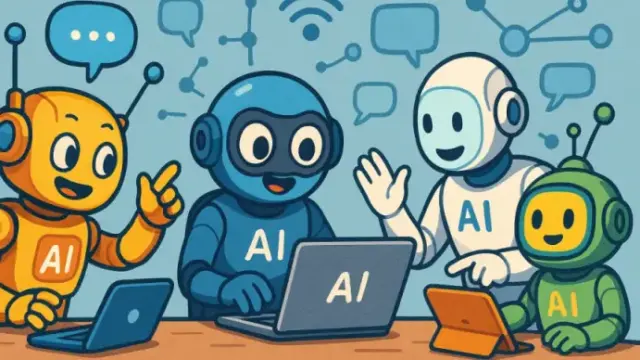
Because the important shift in enterprise software right now isn't a bigger model. It's teams of models. Specialized AI agents plan multi-step tasks, choose their own tools, execute, and coordinate with each other under human supervision — increasingly inside the enterprise's core systems rather than in a chat window off to the side. A year ago this was a research demo; now it is production.
A team holds a goal; a chatbot holds a thread
What changed is not raw model ability. It is organization. A single assistant answers a prompt, and the thread ends there. A team of agents holds a goal, splits it, checks its own work and reports back. That difference sounds cosmetic. It isn't.
In practice, the pattern has settled. A planning agent decomposes a goal and delegates. Specialists handle the pieces — research, data retrieval, code generation, verification. A supervisor agent checks the results before anything reaches a human.
Why teams, though, and not one very capable agent working through the same steps in sequence? The research published in 2026 keeps landing on the same four drivers, and they are engineering, not fashion. Parallel execution cuts task completion time, because the pieces run at once instead of queuing behind each other. Specialization lets each agent focus on a domain-specific subtask instead of being adequate at everything. Multiple agents provide fault tolerance when one fails — the work degrades instead of dying. And the team scales with the complexity of the task in a way a single context window simply does not.
That list maps almost exactly onto how organizations already divide human labor — and that may be the quiet reason this architecture took hold so fast: companies reused their own management theory for agents.
The adoption curve stopped looking like an experiment
The pace startles, by enterprise standards: Gartner projects that by the end of 2026, 40% of enterprise applications will embed task-specific AI agents — up from low single digits just a couple of years ago. The market agrees with the direction: agentic AI expanded from roughly $7.6 billion in 2025 to a projected $10.8 billion in 2026. By enterprise software standards, that is not adoption. That is a land grab.
IDC projects that 40% of roles inside Global 2000 companies will involve working directly alongside AI agents by the end of this year. Read the two figures together: the applications are getting agents, and so are the job descriptions — bought by IT, and written into the org chart by HR.
Returns explain the rush: Deloitte's 2026 State of AI in the Enterprise report found agentic AI deployments returning an average of 171% on investment, with US enterprises at roughly 192%. Numbers at that level do not need a sales pitch. They need a queue, and a governance process that can keep up with it.
Anthropic's 2026 survey adds the texture: 57% of organizations now run agents across multi-stage workflows rather than single tasks, 81% plan more complex cross-functional workflows in the coming year, and 80% report measurable ROI from agents in production. Workers save 40 to 60 minutes a day — and 75% say they complete tasks they previously could not perform at all.
That last figure deserves a pause. Saving minutes is efficiency, and efficiency is easy to argue with. Completing work previously out of reach is capability — a different budget line and a different boardroom conversation. It also explains the industry's fixation on the reasoning models these agent teams are built on: the better the underlying model plans and uses tools, the more a team of such models can be trusted to hold a goal unsupervised for hours instead of seconds.
MCP moves the tools, A2A moves the work
Multi-agent systems need standards the way the web needed HTTP. Two have emerged, splitting the problem cleanly.
MCP — the Model Context Protocol — is the open standard connecting agents to tools, data sources and each other. It grew roughly 2,200% between October 2024 and November 2025, reaching 97 million downloads and over 10,000 enterprise servers as of mid-2026, adopted by Anthropic, OpenAI, Google and Microsoft. When four rivals standardize on the same protocol inside two years, the argument about which protocol wins is already over.
One wart stands out: about a quarter of MCP servers still run with no authentication — which is why managed MCP gateways have become standard in enterprise deployments. Hold the detail in mind. It comes back later, wearing a security badge.
A2A, the Agent-to-Agent Protocol, handles the horizontal layer — agents delegating to agents. Google launched it in April 2025 and transferred it to the Linux Foundation in June 2025, covering inter-agent task delegation, streaming updates, and agent discovery via signed Agent Cards. By mid-2026 the A2A repository held roughly 24,400 GitHub stars, with over 150 organizations in production. The settled architecture is easy to state: MCP for agent-to-tool calls, A2A for agent-to-agent delegation.
Underneath the protocols sit three philosophies. LangGraph, from LangChain, treats workflows as graphs with explicit, debuggable orchestration and human-in-the-loop checkpoints; it has become the default for production teams that need auditability. CrewAI takes the role-based route: define agents by role — researcher, writer, critic — assign tasks, and let the framework manage delegation. Its simplicity made it the on-ramp for thousands of first projects. Microsoft's AutoGen pioneered conversational patterns — agents collaborating by exchanging messages — and has evolved toward more structured orchestration.
The churn itself is informative. Frameworks rose and fell quickly through 2026, but the survivors converged on the same features: explicit state management, human approval gates, observability. Buyers are no longer purchasing demos; they are purchasing control.
Every agent is also a door
Adoption is real. So are the failure modes. Analysts forecast that over 40% of agentic AI projects started today could be scrapped by 2027 — and the causes are rarely model incompetence.
They are operationalization failures: unmanaged semantic drift, as agents and business slowly start meaning different things by the same words; inadequate data grounding; fragile integrations; production design that was never done. Not one item on it is fixed by a better model. Every one of them is fixed — or not — by the organization around the model.
The organizational response is telling. Some 56% of enterprises now have a dedicated "AI agent owner" role, up from 11% in 2024 — companies inventing management for a workforce that isn't human, because autonomy with no owner is how projects end up scrapped.
Governance is chasing deployment, and it is behind. Some 58% of executives cite AI governance as a top security concern — a concern now being written into the international governance rulebook — and 79% of organizations report facing AI adoption challenges. The distance between those numbers and the deployment curve is the story of enterprise AI in 2026.
The pattern separating winners from the scrapped 40% is consistent and unglamorous: narrow, well-instrumented workflows with clear human oversight beat ambitious autonomous visions. The enterprises capturing Deloitte's 171% started with bounded tasks — documentation, reporting, triage — and expanded only after proving value. Which is, of course, exactly the shape of the two deployments this article opened with.
Finance offers the same lesson from the far end of the risk spectrum: autonomous agents in high-frequency trading are trusted with serious money only where the workflow is narrow, measured and supervised.
There is a second reason oversight matters, and it is darker: every agent that can browse, query databases or move money is a new attack surface, and attackers noticed early.
Prompt injection — malicious instructions hidden in web pages or documents, waiting to hijack an agent's behavior — remains the defining security challenge of the agentic era. An agent summarizing emails can be tricked by an email; a research agent, by a poisoned webpage. The agent cannot yet reliably tell its instructions apart from its reading material, and until it can, the humans around it have to supply the judgment.
So the defenses layer up: agent identity and least-privilege tool scoping, so an agent that only reads invoices can't wire funds; content sandboxing for untrusted inputs; human approval gates for irreversible actions; full audit logs. And remember the quarter of MCP servers running with no authentication? This is where that wart stops being trivia and starts being an incident report. The 56% of enterprises that created agent owner roles are, in effect, building a security operations function for a workforce that isn't human.
What, then, decides 2027? The open questions are operational, not theoretical: identity and access management for agents, audit trails, cost controls, and the discipline to kill projects that don't clear their ROI bars. The compute underneath is shifting too — inference is spreading onto open, decentralized networks run by people the big cloud providers don't employ. And multi-agent systems at production scale run into a physical ceiling first: Blackwell B200 clusters are forcing data centers to rethink liquid cooling because air simply cannot move the heat.
The technology has arrived either way. The management layer is still being built. Multi-agent systems are becoming the default architecture for complex enterprise automation; the remaining questions are management questions wearing technical clothes. That is the honest summary of 2026: agents stopped being a demo category and became an architecture — with budgets, owners, protocols and audit logs. What gets built on top depends less on the models than on the discipline of the organizations deploying them.
Sources
- LinkedIn editorial, "Agentic AI Has Arrived — And It's Rewriting the Rules of Work" (Gartner, Deloitte, IDC figures; AtlantiCare and Fortune 500 case studies): linkedin.com
- Towards AI, "Why 2026 Is the Year of Agentic AI" (Anthropic survey data, MCP growth): pub.towardsai.net
- AllClaws AI agent ecosystem report, April–May 2026 (agent owner role, A2A, enterprise vs solo deployment): github.com
- My Superpowers research, "Agentic AI Coding Agent Trends" (MCP 97M downloads, A2A Linux Foundation transfer): github.com
- AllClaws multi-agent coordination research (efficiency, specialization, resilience drivers): github.com
- Ernie's "State of AI Agents 2026" (52% executives deployed, 74% positive ROI, 40% scrapped forecast): github.com