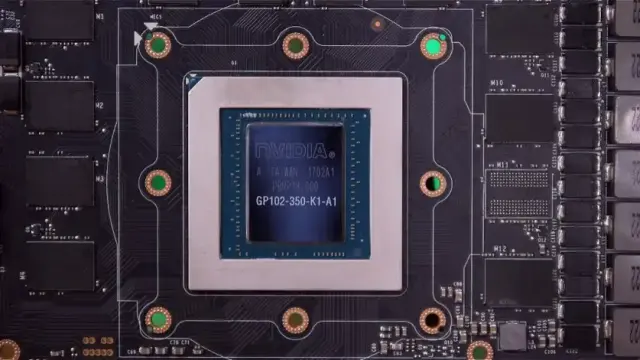
A traditional enterprise rack drew 5 to 10 kilowatts. NVIDIA's flagship rack — the GB200 NVL72, built around the Blackwell B200 — draws more than 120. Somewhere between those two numbers, the data center as the industry knew it stopped working, and a chip best known for arithmetic became a story about plumbing, power grids and national policy.
The performance story got the headlines first. The B200 carries 208 billion transistors, the most ever in a single GPU at its introduction, paired with 192 GB of HBM3e high-bandwidth memory. It was designed for dramatically more AI compute per chip — for training and inference of trillion-parameter models. But the power story changed the buildings. At approximately 1,200 watts, a single B200 draws roughly what a household space heater draws, concentrated into a package the size of a paperback book. Scale that to a full rack and the load exceeds 120 kW, more than ten times what the room was built for. Blackwell's demands forced data center operators, utilities, and even national governments to rethink how AI infrastructure gets built.
Every few years a single chip redraws the map of computing infrastructure, but usually on the spec sheet. Blackwell is different: it delivered the compute, and as a side effect nobody could decline, it forced the buildings, the utilities and eventually the energy policy of nations to reorganize around it. The chip is the cause. Everything after it in this story is consequence.
Air cooling met its limit
That density ended the air-cooling era for high-end AI infrastructure. Physics left no other route: across a 120 kW rack you cannot move enough air to keep silicon within operating temperatures. Industry analysis of the Blackwell rollout has documented that, by early 2026, liquid cooling had become a mandatory standard for more than half of all new data center builds. Pause on that word: not recommended, not preferred — mandatory, for more than half of all new builds, decided before a single GPU is ordered. The cooling plan is now the first plan, which is why hyperscale operators have been replacing air handlers with direct-to-chip liquid cooling across their newest halls.
From the start, NVIDIA designed Blackwell with that reality in mind. The GB200 NVL72 was architected around liquid cooling — cold plates on every GPU, coolant distribution units per rack, facility-level water loops. An option that once looked exotic is now table stakes for AI factories. Look more closely, and NVIDIA is no longer selling chips alone; what it sells is rack-scale computers. Seventy-two Blackwell GPUs and 36 Grace CPUs are fused via fifth-generation NVLink into a single coherent domain with 130 TB/s of GPU-to-GPU bandwidth — one giant virtual GPU.
Cooling such a system as 72 independent hot spots does not work. It has to be engineered as a unified thermal system: coolant distribution sized for the whole rack, leak-detection instrumentation throughout, the rack shipped as an integrated product with compute, networking, power delivery and cooling co-designed. That is why deployments lean on system integrators such as Lenovo instead of treating the job as assembling parts. A unified domain means unified heat — no cool corner of the rack — so the cooling system has to be designed the way the compute was: as one machine.
That integration is also a business decision: when the rack ships as one product, the buyer's job changes from engineering to procurement and operations, and the operator's remaining problems are the site's problems — power, water, and time. Manufacturing tells the same story. The 208-billion-transistor GPU is built on TSMC's custom 4NP process, and the two-die package relies on TSMC's CoWoS advanced packaging to stitch the dies together with the HBM3e memory stacks. Advanced packaging capacity — not just silicon wafers — was among the binding constraints on Blackwell supply through its ramp.
Commissioned in two weeks, in a building built for air
The most telling Blackwell deployment story of 2026 may be Corvex's. The AI infrastructure company signed a multi-year agreement to provide clusters of NVIDIA Blackwell GPUs with NVIDIA Quantum-2 InfiniBand networking to a leading AI company, funded through debt, customer pre-payment and cash on hand — without issuing additional equity. The striking detail is the venue. Corvex, operating inside an existing air-cooled facility, installed and commissioned high-density, liquid-cooled HGX B200 capacity approximately two weeks after the equipment arrived. No facility rebuild. No move to a new site.
Debt, customer pre-payment and cash on hand — no new equity — is the funding stack of a company whose customers are committing in advance. Pre-payment is a demand signal as much as a funding source: an AI company paying early for Blackwell clusters is telling you what scarcity looks like from the buyer's side of the table.
Context matters here. Liquid-cooling retrofits commonly take multiple quarters. Working with Lenovo, Corvex compressed that to weeks. The first capacity shipped in Q1 2026, and the remainder was delivered through Q2 and Q3. Purpose-built liquid-cooled halls remain the gold standard. But Corvex taught the industry that a well-executed retrofit can bring Blackwell online fast — and that the barrier to adoption is increasingly organizational speed, not just engineering.
Set that against the industry's normal clock, where site selection, permitting, power procurement, construction and commissioning together could stretch well past a year. The Corvex example points to a maturing playbook instead — standardized liquid-cooled rack designs, pre-integrated networking, integrators who have done it before. Model capabilities advance quarterly, so a six-month delay can mean training on last year's economics — while the models being trained are no longer research toys but production systems that enterprises now run their operations on. Operators are responding by securing power capacity in advance, standardizing on repeatable cluster designs, and treating deployment velocity as a core competency.
The harder wall is electricity
Thermals, though, are only the first wall. The harder constraint is electricity itself. One large Blackwell cluster can draw as much power as a small city, while utilities in prime data center markets carry interconnection queues running to multiple years. The response has been historic. Microsoft and Google signed landmark deals throughout 2025 and into 2026 for small modular reactors (SMRs) and nuclear plant restarts, to secure 24/7 carbon-free power for their AI clusters. Once the largest technology companies start signing nuclear deals, the constraint is no longer a data center problem at all: the physical power grid has replaced chip supply as the binding constraint on AI growth.
An interconnection queue is a peculiar kind of wall: not a price, which a rich buyer can simply pay, but a line, measured in years, in which the buyer waits for the grid to have room. Small modular reactors and nuclear plant restarts are not purchases of electricity so much as purchases of position — dedicated, round-the-clock, carbon-free supply that does not depend on a queue clearing. When the constraint is time rather than money, companies with money buy their way out of the line entirely.
First the industry worried about getting chips. Then about cooling them. Now about feeding them electricity. Each wall was higher than the last, and each one moved the problem further from the server room and closer to national infrastructure.
Nations and rivals face the same physics
Perhaps the most geopolitically significant Blackwell story is the sovereign AI movement. Nations including the United Arab Emirates, France and Canada are investing billions in domestic Blackwell-based infrastructure to ensure data independence and national security — building under their own laws, in step with the international standards now being written for AI. The flagship is "Stargate UAE," featuring over 100,000 Blackwell units — a shift analysts describe as moving from a "petrodollar" to a "technodollar" economy. Renting compute from US hyperscalers no longer satisfies these nations; they are building AI factories so national models can be trained in their own languages. The motive is data independence; the argument that unlocks the budget is national security. Some future capacity may sit outside the traditional clouds entirely, on open, decentralized inference networks.
NVIDIA does not have the market to itself, and Blackwell's dominance has pushed rival roadmaps harder. AMD's Instinct line, led by the MI300 series and its successors, competes directly for hyperscale training and inference sockets, with an open software stack — ROCm — as its strategic wedge. Google's TPUs — custom ASICs available through Google Cloud — power a large share of the company's own AI workloads and select enterprise customers. Intel's Gaudi accelerators target cost-efficient inference, where the winning argument is price per answer rather than peak performance. Three strategies, three different contests — and one shared engineering bill.
Notably, Blackwell's power envelope raised the bar for everyone: any competitor chasing the high end must now solve the same 100 kW-plus thermal and power-delivery problems. Data center designs across the entire industry are being reshaped in Blackwell's image, regardless of whose silicon ends up in the racks. Deployment timelines tell the same story: once power procurement and construction are counted, greenfield AI factories can still take a year or more, while standardized, integrator-led retrofits collapse that to weeks.
"National security" is the argument that releases billions without a quarterly return calculation, and "data independence" is its civilian twin: a country that trains its national models on rented foreign compute has outsourced a piece of its sovereignty along with the electricity bill. Stargate UAE, with over 100,000 Blackwell units, is the scale at which that argument becomes concrete — not a pilot cluster, but national infrastructure, built to keep the capability at home.
That may be the B200's deepest legacy: thermal engineering, once a facilities concern, became a C-suite topic, with cold-plate design, coolant chemistry, CDU redundancy and leak detection now discussed alongside model architecture. The chip that made AI dramatically more capable also made the data center dramatically more complex — and the operators mastering that complexity are pulling ahead.
Cooling is the constraint that now designs the building. At hyperscale the shift is already decided — AI data centers are replacing air handlers with direct-to-chip liquid cooling because the thermal math leaves no alternative. Heat is not the only wall: moving data between racks is becoming the second bottleneck, which is why silicon photonics breaking bandwidth limits matters as much to capacity planning as any chip roadmap. And the chip race is widening beyond data centers: Huawei's Mate 90 arrived with a Kirin 9050 Pro and a ten-year AI life pitch.
Sources
- PRNewswire, "Corvex Signs Multi-Year Agreement to Provide NVIDIA Blackwell GPUs" (HGX B200 deployment, two-week commissioning, Lenovo case study): prnewswire.com
- Mammoth Times / FinancialContent, "The Blackwell Era" (208B transistors, 1,200W B200, 120 kW NVL72 rack, liquid cooling mandate, SMR deals, Stargate UAE): business.mammothtimes.com
- Future Market Insights via CityBuzz (liquid cooling market context, hyperscale demand): citybuzz.co