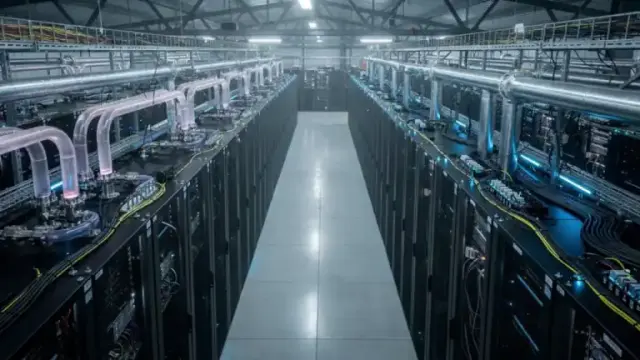
A fully loaded GB200 NVL72 rack pulls more than 120 kilowatts. Read that as a facilities problem, not a computer problem. Every watt turns into heat that has to leave the building, and the traditional way of removing it — blow cold air in, pull hot air out — has run out of road.
A single NVIDIA Blackwell B200 draws approximately 1,200 watts. Stack enough of them into a rack and air stops being a coolant and becomes a bottleneck. Hot spots form, chips throttle to stay alive, and performance collapses exactly when it's needed most. So the industry is doing the obvious thing, decades late: putting liquid on the silicon.
The number that ended the argument
Air is a poor conductor of heat compared to liquid. Water carries roughly 3,000 to 4,000 times more heat per unit volume. For years, clever airflow engineering kept pace — better ducting, better containment, faster fans. The margin was always thin. It was a truce, not a solution.
Modern AI GPUs ended the truce. At 1,200 watts per chip and 120-plus kilowatts per rack, no arrangement of fans and ducting keeps up, and cooling has moved from a facilities afterthought to a first-order constraint on AI performance. In 2026 the transition to direct-to-chip liquid cooling — D2C — has become the defining infrastructure story in AI computing, and it happened because the physics left no alternative.
Follow the failure mode, because it explains the urgency. A rack drawing over 120 kW converts power into heat at the rate of a small industrial furnace, in the footprint of a wardrobe. Air-based designs compensated with volume, but volume runs out, hot pockets form, and chips throttle to protect themselves. The facility pays full price for power and gets a fraction of the compute. Cooling stops being overhead in that moment. It becomes the ceiling on what the hardware can do.
Three ways to put water on the problem
The most aggressive option is immersion: submerge entire servers in dielectric fluid. Thermally, it's superb. Operationally, it asks the most. Immersion demands purpose-built tanks, fluid maintenance, and service procedures most operators simply don't have.
The lightest touch sits at the other end. Rear-door heat exchangers are liquid-cooled doors mounted on the back of the rack that cool the exhaust air as it leaves. They ask almost nothing of the servers, but they treat the symptom — air that already holds the heat — rather than the source.
Direct-to-chip cooling takes the middle path. Cold plates mount directly on the components that generate the heat — GPUs, CPUs, memory modules — and a coolant distribution unit circulates treated water or dielectric fluid through the loop, absorbing heat at the plate. The server stays a server. That's why D2C cold plates are projected to hold 47% of the cooling technology segment in 2026: targeted, compatible with standard designs, and the easiest to retrofit.
The loop itself is worth picturing. Coolant arrives at the rack through the distribution unit, passes through the cold plates sitting on the silicon, and leaves warmer, carrying the heat in liquid form. The heat exchanger hands that heat off to the facility's water system, and the coolant cycles back. Nothing boils, nothing is submerged. Each architecture answers the same question differently: how much of the building, the server and the maintenance routine are you willing to redesign?
Think about it from the operator's chair. A hyperscaler doesn't adopt a cooling technology; it adopts a maintenance regime, repeated across tens of thousands of racks. Immersion asks technicians to work on dripping hardware. Rear-door units can't reach the heat at its source. Cold plates ask crews to service machines the way they already know how. At fleet scale, that familiarity is worth as much as the thermal numbers.
The dominant D2C implementations are single-phase systems, where the coolant stays liquid throughout the cycle. Market analysis cited by GlobeNewswire puts single-phase at the largest share of the D2C coolants segment for practical reasons: it works with commercial water-glycol blends and existing server architectures. The coolants market itself is projected to grow from $0.18 billion in 2026 to $1.30 billion by 2032, a 38.6% annual growth rate. Markets don't compound at that speed around experiments. Technologies that demand everything change at once tend to stay demonstrations. Single-phase D2C asks for the smallest change that solves the problem.
Two scoreboards: power and water
Cooling accounts for a large share of non-compute energy use, so operators keep score with PUE — the overhead a facility adds on top of the energy its computers consume. Liquid attacks that overhead three ways: heat removed closer to the source, higher compute density per rack, less dependence on chillers and air handlers.
Goldman Sachs estimates put achievable PUE at 1.05 to 1.15 in liquid-cooled environments — only 5 to 15% energy overhead beyond the IT load itself, against materially higher figures for legacy air-cooled halls. Goldman also estimates that 76% of AI servers deployed by the end of 2026 will be liquid-cooled. At hyperscale, each fraction of a PUE point carries a very large absolute energy bill behind it. And the density dividend matters as much as the efficiency one: more AI work per square foot means more revenue standing on the same concrete.
That 76% estimate quietly reframes what "standard" means. If three-quarters of the AI servers deployed by the end of 2026 are liquid-cooled, air cooling isn't the default with a liquid exception anymore — it's the legacy case, and the 1.05 to 1.15 range sets the competitive bar. Efficiency at that level isn't a sustainability garnish. It's a cost position.
Water keeps the second score: evaporative towers in arid regions consume enormous volumes, so the industry tracks Water Usage Effectiveness — liters per kilowatt-hour of IT energy. Closed-loop systems recirculate treated water instead of evaporating it, driving WUE dramatically lower. NVIDIA's reporting around its Rubin AI servers in June 2026 pointed to a fan-free, closed-loop, 100%-liquid-cooled design running coolant at 45°C — warm enough to reject heat without evaporation in favorable climates, which the company says can drive water use near zero.
The implication is strategic. A facility that needs little water can be sited where power is cheap and abundant rather than where water permits are obtainable. In arid regions, water isn't just a bill, it's a permit, a community negotiation, a hard constraint that has stalled projects outright. A closed-loop design at 45°C loosens that constraint at the source, and siting can follow power price first.
The buildings that already exist
Not every operator is building greenfield AI factories. Thousands of existing data centers were designed for 10–15 kW air-cooled racks and now face tenants demanding GPU density. The retrofit question — adding liquid cooling without gutting the building — has become an engineering discipline of its own.
D2C's advantage here is decisive. Cold plates integrate with standard server form factors, single-phase loops use conventional plumbing, and operators can add distribution units and facility water connections incrementally, rack row by rack row. Rear-door exchangers offer a lighter first step: bolt-on doors that capture exhaust heat without touching the servers. The Corvex deployment shows how far the techniques have come — liquid-cooled HGX B200 capacity commissioned in about two weeks inside an air-cooled facility. That matters: the installed base represents trillions in sunk capital owners are keen to sweat, not strand.
Put the gap in numbers and the surgical approach is obvious. A hall designed for 10–15 kW racks is being asked to host racks drawing over 120 kW — roughly an order of magnitude beyond its design point. No incremental fan upgrade spans that gap, and a full rebuild strands a working building for quarters. The row-by-row path threads it: convert one row, prove it, convert the next, with the facility earning throughout. Owners of the installed base aren't choosing between sweating their assets and joining the AI buildout anymore.
The money confirms the direction. Future Market Insights projects the AI data center liquid cooling market at $3.7 billion in 2026, growing to $17.83 billion by 2036 — a 16.9% compound annual growth rate. Hyperscale AI data centers are expected to represent 55% of deployment demand in 2026, as cloud providers pour billions into AI infrastructure. And the tell is in the contracts: long-term procurement agreements between cooling vendors and hyperscale operators. Operators sign multi-year deals when the architecture decision is made and the problem becomes securing enough hardware to keep up with build schedules. The demand split matters too: when a hyperscaler standardizes on a cooling architecture, supply chains reorganize around it, and the rest of the market inherits mature, available, priced equipment instead of prototypes.
Training gets the headlines, but inference may be the bigger driver. Training clusters run hot in bursts; inference serving runs 24/7 at steady load, making cooling efficiency a permanent operating cost. Steady, always-on inference is exactly the workload enterprises are pulling in-house, deploying open-weight models on-premises for data sovereignty. Those private installations inherit the same physics at smaller scale: dense GPU racks, heat air can't clear, a PUE figure on the operating budget every hour. As multi-agent setups leave pilots behind for production, and open-weight models spread onto open, decentralized inference networks — all of it under governance frameworks that hardened into law this year — liquid-cooled inference racks are becoming standard in private data centers too.
There's a feedback loop in that. Every enterprise that brings inference in-house becomes a small cooling customer, normalizing liquid in buildings never designed as AI factories. The retrofit techniques proven in hyperscale halls are precisely what those smaller sites need, because they can't rebuild either. Training built the industry's liquid-cooling muscle; inference, running around the clock in thousands of ordinary facilities, will keep it exercised.
The trajectory points one way: higher densities, more liquid. The operator's question is no longer whether to adopt liquid cooling. It's which architecture to standardize on, and how fast. For AI-focused facilities, thermal design is now inseparable from compute strategy. NVIDIA's Blackwell B200 thermal engineering analysis explains why densities crossed the line air could serve. Not everyone accepts bigger centralised facilities — decentralised AI inference protocols challenging the cloud monopolies argue for spreading the load so heat never concentrates, a position that strengthens with every gigawatt campus announced.
Sources
- Future Market Insights, "AI Datacenter Liquid Cooling Market to Reach USD 17.8 Billion" (via OpenPR): www.openpr.com
- Future Market Insights market summary (via CityBuzz, June 2026): citybuzz.co
- Cyfuture, "Liquid Cooling Improves Efficiency in AI Data Centers: Why 2026 Is the Turning Point" (citing Goldman Sachs estimates and NVIDIA Rubin reporting): cyfuture.cloud
- GlobeNewswire, "Data Center D2C Coolants Market to Reach USD 1.30 Billion by 2032" (July 2026): www.globenewswire.com
- Mammoth Times / FinancialContent, "The Blackwell Era" (B200 power figures, GB200 NVL72 rack density): business.mammothtimes.com