
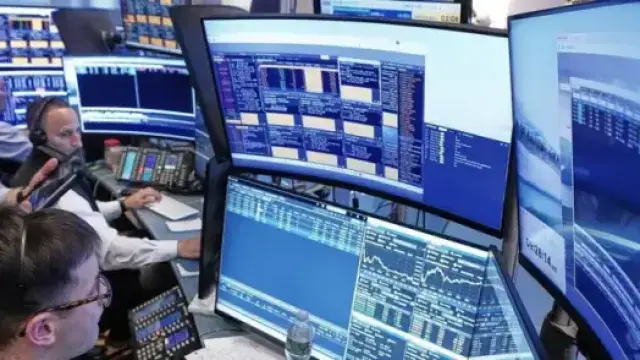
The machines were already running the market before anyone called them agents. Roughly half of all trading volume in US equity markets is high-frequency, according to the European Central Bank's research bulletin on HFT competition and market liquidity, and the share runs between 24% and 43% in European equity markets. Consultancy TABB Group has put the US figure as high as 70%. Machines quote the prices. Machines take the other side. And in moments of stress, machines are the ones that walk away.
That was the market before agentic AI arrived. High-frequency trading has been the most automated corner of finance for two decades. What is arriving now is a different kind of machine: systems that perceive market data, reason about it, plan multi-step strategies and act across connected software on their own. Banks, brokers and trading firms are deploying them into research, execution, risk management and client workflows. Regulators in Washington, London and Basel are racing to understand what happens when increasingly autonomous machines trade at machine speed.
The rule book ends here
Traditional algorithmic trading follows rules humans wrote and tested. A market-making algorithm quotes both sides of an order book, updates prices in microseconds and flattens its inventory before the close. It is fast. It is also, in a specific sense, predictable. Its behaviour is bounded by its programming. If you have the rule book, you have the range of things it can do.
An agent built on a large language model works differently. It can ingest unstructured information — news, filings, sentiment — reason about a portfolio objective, break a task into steps, call tools such as execution algos or risk engines, and adjust its plan as conditions change. No fixed rule book. A reasoning process instead.
JPMorgan's chief analytics officer, Derek Waldron, has described the firm's move beyond single-task copilots toward agentic systems that write code and control software across multi-step workflows, telling CNBC that longer-running autonomous agents are expected in 2026. Copilots assist. Agents run. JPMorgan's in-house LLM Suite reached 200,000 users within eight months of its 2024 rollout, and its 2025 annual report says AI-enabled transaction-screening teams now review more than twice the volume while cutting manual checks in half. Morgan Stanley partnered with OpenAI on an adviser assistant built on its own research in 2023, then expanded an OpenAI-powered assistant across its institutional securities division.
Look at what those deployments actually are, though. Agentic support around human bankers — not autonomous trading. The fully autonomous "agent as portfolio manager" remains mostly aspirational inside regulated institutions, because the compliance burden is so high. Quant funds long used machine learning for pricing, hedging and execution; what is new is the reasoning layer above it.
Two disasters, one baseline
Any honest account of agents in markets has to walk through the two disasters that define the baseline — both happened with automation far dumber than what is being connected now.
On May 6, 2010, an automated sell program helped send the Dow Jones Industrial Average down almost 1,000 points — about 9% — within roughly half an hour, before the market recovered most of the loss the same day. The joint SEC–CFTC report traced the trigger to a large trader's program that sold 75,000 E-mini S&P 500 futures contracts, worth about $4.1 billion, at 9% of recent trading volume "without regard to price or time." High-frequency traders first absorbed the selling, then began aggressively selling themselves — a "hot potato" effect that amplified the decline. The report did not primarily blame HFT. It asked whether HFT provides continuous liquidity, or vanishes when needed most.
Knight Capital is the deployment-error version, and it is worse in one way. No market panic. No external trigger. Just a defective function. On August 1, 2012, a defective function in Knight's equity order router activated and began firing erroneous orders. In about 45 minutes of uncontrolled trading across 140 stocks, Knight lost $440 million — roughly $10 million per minute, as the New York Times estimated. The loss exceeded the firm's entire second-quarter revenue that year and forced a rescue recapitalisation; the SEC later fined the firm $12 million for violating the market access rule.
Agents add distinct concerns on top of that inheritance. Herding and correlation: if many firms train agents on similar data and models, the agents may react to the same signals simultaneously, selling into the same falling market or withdrawing liquidity at once. A faster, harder-to-interrupt version of the hot potato. Opacity: an agent chaining reasoning steps and tool calls is harder to audit than a deterministic algorithm, and reconstructing why it acted during a crash may be far harder than reading a rule book. Speed of contagion: agents operating across venues and asset classes can transmit a shock from futures to equities to options in seconds — a dynamic already familiar from DeFi, where $1.3 billion in 2026 hack losses showed how automated systems fail when nobody can slow them down. And overreliance: FINRA has warned algorithmic recommendations inside trading systems have already caused unintended market disruptions, and that AI can accelerate human error as well as fraud. Four worries. All of them extensions of things that have already happened, which is what makes them hard to wave away.
The lab result that won't settle it
Then comes the awkward counter-evidence. A US Federal Reserve staff working paper tested large language models in classic herding scenarios and found AI agents made rational decisions 61% to 97% of the time, versus 46% to 51% for humans. Information cascades appeared in 0% to 9% of AI decisions, compared with 20% for humans. And when AI agents did cascade, they tended to trade against the trend. The researchers concluded AI agents herd less than human professionals, while cautioning that AI could still "fundamentally alter market dynamics in ways that are not yet fully understood."
Hold the two halves together and the debate becomes clearer, and less comfortable. Both disasters happened before generative AI existed — deterministic code, written and tested by humans, lost $440 million in 45 minutes entirely on its own. The 2010 and 2012 episodes are not arguments against agents specifically; they are the baseline failure rate of automated trading itself. Agents inherit that baseline and add autonomy, correlation and opacity on top. Whether the reasoning layer makes the system safer — the Fed's lab evidence says it might — or simply faster at being wrong in unison is the question supervisors now worry about. A lab is not a falling market.
The supervisors stopped waiting
Whatever the answer, regulators have stopped treating it as a future problem. The SEC put AI at the top of its risk list in its 2025 examination priorities: the Examination Division said it would assess registrants' policies, monitoring controls and fraud prevention where AI is used in advisory operations, including portfolio management and trading. And the fraud side isn't hypothetical. In September 2026, the SEC charged entities behind "Cryptoaiml" and "TSAI" with alleged AI-trading-bot scams that took more than $15 million from roughly 2,000 investors — a reminder that the AI-trading label itself has become a fraud vector.
FINRA's 2026 Annual Regulatory Oversight Report, published in December 2025, expects firms to assess compliance obligations before deploying generative AI, establish governance frameworks, and control for hallucinations and bias — and, explicitly, "develop oversight for autonomous AI agents, including tracking actions and restricting access." That's not guidance about a chatbot. That's a supervisor describing how you keep hold of a system that acts on its own.
Higher up, the Financial Stability Board put AI on the agenda in August 2026: FSB Chair Andrew Bailey — also Governor of the Bank of England — warned G20 finance ministers that frontier AI models "may have the ability materially to alter the speed, scale and economics of cyber risk, which could undermine market confidence system-wide," calling for safe model release standards and stronger recovery capabilities. The Bank for International Settlements warned in its 2026 Annual Economic Report that the AI investment boom ranks among the largest technology-driven investment booms in US history, with its scale and debt reliance raising questions about sustainability and financial stability.
For investors, the practical reading is unglamorous: the liquidity on your screen is largely machine-provided, and it can disappear under stress. That is one reason reserve managers have been buying gold at a record pace, and why plenty of portfolios still lean on dividend growth strategies built for volatile markets rather than on speed. The agents joining those machines are powerful, fast, and still only partially understood — by the firms deploying them and the regulators watching them.
Disclaimer: This article is general information for educational purposes only and is not investment advice, financial advice, or a recommendation to buy or sell any asset. Markets are volatile and past patterns do not guarantee future results. Consult a licensed financial professional before making investment decisions.
Agents trading at machine speed are attracting the attention agents everywhere are starting to get. The FTC has opened its first probe into rogue AI agents, and while its remit is consumer protection, the questions about accountability for autonomous actions apply to trading desks verbatim. Verification is the other half of the problem — SynthID's open detector only finding watermarks rather than fakes shows how far provenance tooling still has to go before an audit trail can be trusted on its own.
Sources
- Congressional Research Service — "Artificial Intelligence in Capital Markets: Policy Issues": congress.gov
- SEC 2025 Examination Priorities (AI as emerging financial technology), via Lexology: lexology.com
- SEC charges against Cryptoaiml and TSAI AI-trading frauds (Sept 2026), via AlphaBetaStock: alphabetastock.com
- FINRA 2026 Regulatory Oversight Report (GenAI and autonomous agent governance), via Cybersecurity Insiders: cybersecurity-insiders.com
- FINRA leaders on AI and market disruptions, via Traders Magazine: tradersmagazine.com
- FSB Chair Andrew Bailey's G20 letter on frontier AI (Aug 2026), via Wealth Professional: wealthprofessional.ca
- FSB warning on frontier AI and financial stability, via PYMNTS: pymnts.com
- BIS 2026 Annual Economic Report on the AI investment boom, via PYMNTS: pymnts.com
- Federal Reserve staff paper on AI agents and herding, via Investment Executive: investmentexecutive.com
- ECB Research Bulletin on HFT competition and market liquidity: ecb.europa.eu
- SEC–CFTC joint report on the May 6, 2010 flash crash, via Computerworld: computerworld.com
- CRS — "High-Frequency Trading: Background, Concerns, and Regulatory Developments": congress.gov
- Knight Capital 2012 glitch, AIAAIC incident repository: aiaaic.org
- Knight Capital $440 million loss (AP, Aug 2012), via Phys.org: phys.org
- JPMorgan agentic AI roadmap and Derek Waldron statements, via Tech in Asia (citing CNBC): techinasia.com
- Morgan Stanley–OpenAI partnership for advisers (2023), via CNBC: cnbc.com
- Kitces — "AI Compliance: Applying Existing SEC Regulatory Frameworks": kitces.com