
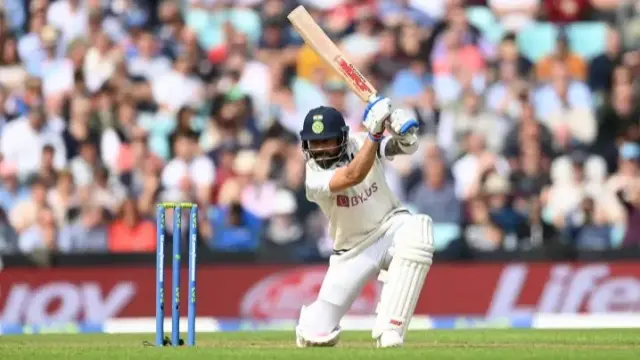
The oldest script in modern cricket ran again on September 27, 2026, in Thiruvananthapuram.
West Indies had posted 296. Virat Kohli, 37 years old and playing his first international innings in over two months, made 139 not out off 88 balls, and India chased the target down with eight wickets and more than eight overs to spare. There is a particular silence that falls over a ground when Kohli is batting in a chase and the equation starts to tighten. It isn't the silence of despair. It's the silence of an audience that has seen this film before and knows, with a certainty that borders on superstition, how it ends.
Across eighteen years of one-day international cricket, Kohli has turned the run chase from a team exercise into a personal art form — and the method behind it can be studied, broken into parts, and understood.
The ledger is absurd
As of late September 2026, Kohli has scored 8,638 ODI runs while chasing, with 30 hundreds. Twenty-five of those hundreds came in successful chases — a conversion rate above 83 percent. His average while chasing sits around 64, well clear of AB de Villiers in second place; in chases India go on to win, it climbs to roughly 90, the highest of any great ODI batter. Sachin Tendulkar and Rohit Sharma, the next-best century-makers in successful chases, have 14 each. Kohli has 25. Nearly double either of them.
The gap between the two averages — around 64 in all chases, roughly 90 in the ones India win — is its own piece of evidence. Some of it is arithmetic: a batter who finishes a chase unbeaten collects the not-out, and not-outs lift averages. But the size of the gap points beyond arithmetic: the typical Kohli chase hundred is not a heroic effort in a losing cause; it is the load-bearing innings of a win.
Melbourne is the one they'll retell
October 23, 2022. India against Pakistan, T20 World Cup, a sold-out Melbourne Cricket Ground with 90,293 people inside, chasing 160. India collapsed to 31 for 4 in 6.1 overs against Shaheen Afridi, Naseem Shah and Haris Rauf. Kohli was 5 not out off 9 balls. The game looked gone. What followed was a 113-run stand with Hardik Pandya (40), built first on survival — ones and twos, taking the game deep — then on one of the most violent gear changes the sport has produced.
The survival phase is the part highlight packages skip, and it is the part the method is built on. Afridi, Naseem and Rauf with a new ball, under lights, in front of 90,293 people — the orthodox response is to counter-attack before the game drifts beyond reach. Kohli and Pandya did the opposite. They absorbed: ones into the gaps, twos where the outfield allowed, no shot played merely to relieve pressure. The equation worsened on paper with every quiet over, and improved in reality, because every over survived moved the chase closer to the phase where a set Kohli is close to unstoppable.
With 48 needed off the last three overs, Kohli struck Shaheen for three boundaries. Then, with 28 needed off 8 balls against the towering Rauf, he did the thing the MCG will never forget: a back-of-a-length delivery punched straight down the ground for six, followed by an extraordinary flick over fine leg for another maximum. Sixteen were needed off the final over. A tangle of no-ball, free hit, wides and Kohli's ice-cold game sense took India home off the last ball, with R. Ashwin — on strike for the final delivery, scores tied — clearing the infield to spark pandemonium. Kohli finished 82 not out off 53 balls.
Tendulkar's verdict, posted that night, is now part of the innings' legend: "It was undoubtedly the best innings of your life. It was a treat to watch you play, the six off the back foot in the 19th over against Rauf over long on was spectacular!" Babar Azam was equally generous: "All credit to Kohli and Pandya. It wasn't easy with the new ball." When the greatest batter of the previous generation and the losing captain say the same thing in different words, the innings becomes a reference point — the standard against which every later chase gets measured.
Finished years before Melbourne
Melbourne wasn't an invention. It was a rerun, at higher stakes, of a template visible a decade earlier. In Hobart, in February 2012, India were chasing 321 against Sri Lanka, and needed to get there inside 40 overs to stay alive on bonus points. Kohli's 133 not out off 86 balls remains one of the most audacious ODI chases ever played. India got home in 36.4 overs. Disdain for the required rate, placement over power, a finish so early it embarrassed the equation: the full method, in one innings, from a 23-year-old. Weeks later, at Mirpur in the 2012 Asia Cup, his 183 — still his highest ODI score — chased down 330 against Pakistan with something approaching contempt.
Four years on, at Mohali in March 2016, came the T20 version: a virtual quarter-final against Australia, 161 to win, India 49 for 3. Kohli's 82 not out off 51 balls was controlled fury — seven boundaries, most struck with a still head and a full face — taking apart Faulkner and Coulter-Nile with 38 needed off the last three overs. By then the pattern had a shape anyone could read: survive the wreckage, refuse the panic, choose the over, finish early or finish at the death — but finish. In Colombo, in September 2023, his unbeaten 122 carried India past Pakistan again on a reserve day. And in Dubai, at the 2025 Champions Trophy, an unbeaten 100 against Pakistan carried him past 14,000 ODI runs in just 287 innings — the fastest to the mark in history.
Take it deep, pick your bowler, run them ragged
Strip the romance away and the chasing follows a learnable structure — a tactical blueprint, much like the ones analysts now apply to Formula 1's ground-effect machinery.
The first principle is depth. Kohli refuses to let the game end early. At the MCG he was 5 off 9 with the rate climbing; at Mohali he rebuilt from 49 for 3. The logic is mathematical as much as psychological: wickets in hand in the last five overs are worth more than runs in the first ten, because a set batter facing a tiring attack can score at rates no new batter can match. Every over he survives transfers pressure from the batting side's dugout to the bowler running in.
The second principle is target selection. Kohli does not attack evenly; he picks his moment and his victim. At the MCG it was Rauf's 19th over — two sixes that broke the back of the chase. At Mohali it was Faulkner's death overs. Absorb the opposition's best, then dismantle the weakest or most tired bowler in a single over that flips the required rate from impossible to manageable.
The third part is the least televised and the most relentless: the running. Kohli converts ones into twos with a frequency that breaks fielding sides — their spirit, and their over-rate calculations. In long chases the twos do double duty: they keep the scoreboard moving without risk, and they exhaust fielders chasing every ball to the rope on grounds as vast as the MCG. It is fitness as tactics, inseparable from the method.
Teams have tried everything else. Pakistan at the MCG bowled superbly for fifteen overs and lost. Australia have tried pace, England have tried swing, spinners have tried to strangle him through the 3.8-runs-an-over middle phases that the data says should kill chases. Every plan meets the same problem: his game has no single pressure point. Bowl full and he drives. Bowl short and he pulls. Bowl wide and he reaches. India had a finishing lineage before him — MS Dhoni built a tactical legacy on closing games — but the only strategy that has ever worked on Kohli with any consistency is dismissing him early. Which is why the first ten balls of every Kohli chase are the most valuable in cricket.
That last point reframes every Kohli innings before it starts. Fielding captains know the data: the plans, the match-ups, the middle-overs squeeze all have a poor record against a set Kohli, so the rational attack is front-loaded — the new ball, the best bowler, the most aggressive fields, everything spent on the small window before the method engages. Teams plan against most batters for fifty overs. Against Kohli they plan for ten balls, and treat everything after that as damage limitation.
Which returns us to Thiruvananthapuram, and why it belongs in the same file as Melbourne rather than in a farewell scrapbook. That 139 not out was his 55th ODI century — reached in just 74 balls — extending his own world record ahead of Tendulkar's 49, and his 25th hundred in a successful run chase. In the same innings he passed 15,000 ODI runs, doing it in 303 innings, 74 fewer than Tendulkar needed. It was also his 86th international century overall, leaving him 14 short of Tendulkar's hundred hundreds.
The stage has narrowed. He plays ODIs only now. He retired from T20Is after India's 2024 World Cup win, and from Tests in May 2025. The 2027 ODI World Cup is confirmed as his final World Cup. At 37, still India's ODI anchor, he is adding entries to a reputation already built — most recently 296 runs in Kerala, against a side with no answer to the oldest script in modern cricket.
Kohli's chasing method did not appear from nowhere; it was refined in the slipstream of the original. Dhoni's tactical legacy as Captain Cool supplied the template — take it deep, keep wickets, trust the last five overs — that Kohli industrialised. Cross-sport comparisons are usually lazy; this one earns its place: Messi's international career and its long wait for trophies traced the same arc of individual mastery finally bending a tournament to its will.
Sources
- tryball.in — Virat Kohli ODI stats: chase record, 15,000 runs, 55 hundreds (Sept 2026): tryball.in
- NDTV Sports — India vs Pakistan, T20 World Cup 2022: 82* at MCG: sports.ndtv.com
- Hindustan Times — Tendulkar's reaction to Kohli's MCG knock: hindustantimes.com
- Sportstar — Kohli's greatest T20I knocks: Mohali 2016 to Melbourne 2022: sportstar.thehindu.com
- india.com — Babar Azam hails Kohli, Pandya after MCG win: india.com
- Free Press Journal — 55th ODI century, 74 balls, vs West Indies (Sept 27, 2026): freepressjournal.in
- Indian Express — Kohli's 55th ODI ton, 15,000 runs: indianexpress.com
- gg2.net — Kohli's 86th century; 14 from Tendulkar's 100: gg2.net
- Khel Ja — Kohli vs Tendulkar ODI records; 2027 World Cup last: khelja.in