
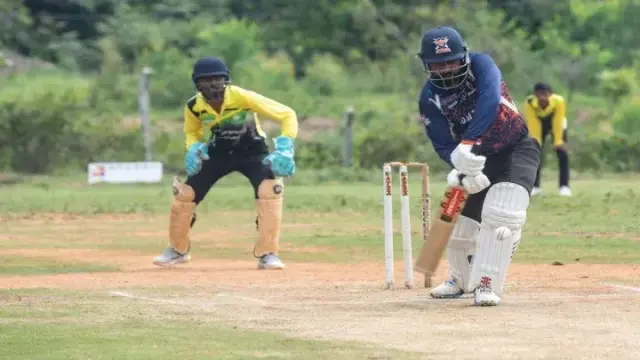
Pakistan have changed their T20 captain again. Salman Ali Agha is out, not just from the captaincy but from the squad entirely, and Sahibzada Farhan takes over for a three-match series against Sri Lanka in Rawalpindi.
The Pakistan Cricket Board announced the move on a Monday, naming squads for the T20 series and for an ODI tri-series against Sri Lanka and England that follows it. Farhan's appointment came days after he led a second-string Pakistan side to a silver medal at the Asian Games in Japan, where they lost the final to India on the Saturday. It is a swift rise. In March, Farhan finished as the T20 World Cup's leading run-scorer, making 383 runs at a strike rate of 160. Now the opener who was scoring the runs has been handed the team as well.
Why Agha paid the price
No official reason was given for removing Agha. The numbers, though, tell most of the story. Under him, Pakistan won 31 of their 50 T20 internationals, a respectable return on paper, but they failed to reach the semi-finals at the year's World Cup, and in Pakistan cricket a World Cup shortfall tends to settle arguments about the captaincy.
There was recent friction too. Agha was one of seven players sent home midway through the Test tour of England only weeks before the announcement. Whatever the selectors' long-term thinking, his position had been weakening for a while. Reports in Indian media said the selectors had already hinted at building towards the 2028 T20 World Cup, which Australia and New Zealand will co-host. Dropping the captain from the squad altogether, rather than letting him play under Farhan, fits that reading. This is not a handover. It is a reset.
Farhan becomes Pakistan's fourth T20 captain in two and a half years. That churn is its own story, and it mirrors the instability that has followed the side through formats, much as the women's team endured a hard tournament in their T20 World Cup clash with India at Edgbaston. Continuity has become the rarest selection of all.
Two captains, one fortnight
The split between formats is deliberate. While Farhan leads the T20 side, Shaheen Shah Afridi keeps the one-day captaincy for the tri-series, which was scheduled to start on October 18 with Pakistan playing Sri Lanka in the opener. Agha, dropped from the T20s, keeps his place in the ODI squad. Babar Azam, a former captain in both formats, is included in the ODI group but is not part of the T20 squad. Neither is Shaheen.
So Pakistan run two leadership tracks at once. Farhan gets the shortest format and a home series to make his case. Shaheen gets the 50-over side and a tri-series that includes England. It is either smart succession planning or a divided dressing room waiting to happen, and the matches ahead would say a lot about which.
The T20 squad itself leans young and familiar at the same time. Fakhar Zaman, Saim Ayub and Naseem Shah bring experience. Shadab Khan and Abrar Ahmed lead the spin options, with Sufiyan Moqim also included. Khawaja Nafay is the wicketkeeper in the group. Hasan Nawaz, whose hitting lit up the Asian Games run, keeps his place after the final against India in Nisshin, where Pakistan fell 19 runs short.
One name appears in both squads and deserves a line of his own. Razaullah was called up to both after a Test debut against England at Edgbaston the previous month in which he scored 81 and took four wickets. Maiden call-ups rarely arrive in pairs. His suggests the selectors see a cross-format player, not a stopgap. Senior wicketkeeper Mohammad Rizwan, already out of the T20 picture earlier in the year, is also absent from the ODI squad. A changing of the guard is rarely announced as one. This is what it looks like in practice.
The fifteen names
For the Sri Lanka series, Pakistan's 15 was: Sahibzada Farhan (captain), Abdul Samad, Abrar Ahmed, Arafat Minhas, Fakhar Zaman, Hasan Nawaz, Muhammad Imran Randhawa, Khawaja Nafay, Maaz Sadaqat, Naseem Shah, Razaullah, Saim Ayub, Mohammad Salman Mirza, Shadab Khan and Sufiyan Moqim.
The ODI squad for the tri-series was: Shaheen Shah Afridi (captain), Abrar Ahmed, Salman Ali Agha, Arafat Minhas, Babar Azam, Faheem Ashraf, Fakhar Zaman, Muhammad Ghazi Ghori, Haris Rauf, Hasan Nawaz, Naseem Shah, Razaullah, Saad Baig, Saim Ayub, Shadab Khan and Sufiyan Moqim.
Read the two lists side by side and the selectors' thinking is visible. Seven names carry across both squads, but the leadership and the wicketkeeping change completely between formats, and the T20 group is built around Farhan's own opening partnership with Saim Ayub. The ODI group keeps the senior core — Babar, Agha, Haris Rauf — that the T20 reset set aside.
What Farhan walks into
The T20 series was scheduled to start on a Friday in Rawalpindi, with the three matches running across the following days. Sri Lanka at home is a kind fixture list for a new captain, on familiar pitches, in front of home crowds. It is also a trap. Lose a home series to Sri Lanka with a squad built in your image, and the same selectors who talked about 2028 will start answering questions about the present.
Farhan's own form is his best protection. Captains who are scoring runs at the top of the order, at a strike rate of 160, get longer leashes than captains who are not. His Asian Games campaign helps as well: he has just led most of these younger players through a tournament, and silver medals, even in defeat, build a dressing room's belief that the man in charge knows the way through a knockout week.
The longer question hangs over the structure rather than the man. Pakistan's T20 side has now cycled through four captains in two and a half years, spanning the same period in which domestic storylines like the PSL draft and its fast-bowling resurgence promised a settled pipeline. Pipelines do not settle anything if the top job changes hands every few series.
And hovering over all of it is the 2028 target. If Farhan is genuinely the captain for that World Cup, he needs what none of his recent predecessors got: a run of series judged as preparation rather than auditions. The great chasers of the modern game, the standard set by players like Virat Kohli in his years leading India's white-ball sides, were built on backing that survived bad months.
Pakistan say they are building for 2028. Fine. Building means the captain who starts the cycle should be allowed to finish it, or at least to fail over a distance longer than one home series. Farhan's first test was Sri Lanka at home. His second, and harder, test is whether his board still believes in its own plan by the time the tri-series ends and the questions start again.
The calendar does not give the new arrangement long to settle. The T20 series against Sri Lanka runs first, starting Friday in Rawalpindi. Then, from October 18, the ODI tri-series begins at the same venue, with Pakistan facing Sri Lanka in the opener and England also in town. Two captains, two formats, one fortnight, one home crowd watching both experiments at the same time. That overlap tests the messaging as much as the cricket. If Farhan's T20 side plays boldly and wins, questions follow Shaheen about whether the same energy applies to his one-day team. If Shaheen's ODI side clicks while the T20s stumble, the reverse conversation starts. Split captaincy can work. It rarely works quietly.
Farhan at least starts with a fresh memory of tournament leadership. In the Asian Games final in Nisshin, his Pakistan side posted a chase of real substance, reaching 192 for 6 in reply to India's 211 for 6 before falling 19 runs short. Losing a final hurts. Leading an under-strength side into one, and pushing the favourites into the last overs, is still a credential, and the selectors have plainly treated it as one.
Selection watchers will also track how the new captain uses his resources. Naseem Shah's pace, the spin trio of Shadab, Abrar and Sufiyan, and a batting order built around his own opening partnership with Saim Ayub give Farhan more options than Agha often seemed to trust. Whether he rotates boldly or settles quickly will tell the crowd in Rawalpindi what kind of captain they have been given.
None of this guarantees him time. Pakistan's recent history says the plan changes with the results, and the results were about to start arriving three matches at a time. But for the first time in this cycle, the stated reason for a change, building towards a World Cup two years away, actually matches the age profile of the squad chosen. If the board means it, Farhan is not a caretaker. He is the project. The series that starts on Friday is where the project either takes root or becomes the next entry in a list of captains that keeps getting longer.
There is one more thing working in his favour, and it should not be underestimated. He was not the compromise candidate. He was the form candidate: the World Cup's top scorer in March, a tournament captain in October, and now the board's chosen man. Appointments made on form tend to command a dressing room faster than appointments made on seniority, because every player in that room watched the runs being scored. Farhan starts with authority he earned in public, not authority handed down in a press release. What he does with it in Rawalpindi is the story of the next ten days.
A captaincy change is judged by the first series, not the press release. Farhan's begins at home — the Pakistan vs Sri Lanka T20 preview, with a new side playing three nights in Rawalpindi, is where the reset either settles or unravels. The standard he will be measured against is unforgiving; MS Dhoni's tactical legacy remains the template for how a captain's calm, rather than charisma, wins short-format tournaments.
Sources
- Reuters: Reuters
- NDTV Sports: NDTV Sports
Explore live market benchmarks, 360° hardware specifications, and regulatory customs duty breakdowns updated daily: